
Recruiting tips
Five questions to ask a vacancy before you publish it
A practical vacancy checklist: agree the role’s purpose, candidate requirements, employer offer, sourcing channels and selection process before publishing.

Some problems with a vacancy are built in before it is even published. The role was described from an old template, the profile was copied from the previous employee, and the job post was generated from the job title. Then the team spends months sorting through unsuitable résumés.
To check a vacancy before publishing, work through five questions that can reveal these contradictions. Go through them in this order: there is no point discussing channels and the text of the post until the team has agreed on the content of the role and the value of the offer.
The sequence is easy to remember because it follows the logic of marketing. A marketer first checks whether there is demand for the product, then defines the buyer, explains why the product is better than the competition, picks advertising channels and only then sets up the customer’s path to purchase. In hiring, the product is a job at your company, and the buyer is the candidate.
1. Why does this role exist?
Start with the expected business result, not a list of duties. What problem will the new person solve, what will they own, and how will you know the work is paying off?
This conversation clarifies the role’s place in the team, priorities for the coming period, the style of the manager the person will report to, and the limits of responsibility. It is also worth checking whether the pay matches the market and the complexity of the work.
Replacing an employee deserves a separate conversation. While the previous person was in the job, the business, structure or goals may have changed. Maybe the role is needed in a different form today — or not at all.
2. Who do you need to find?
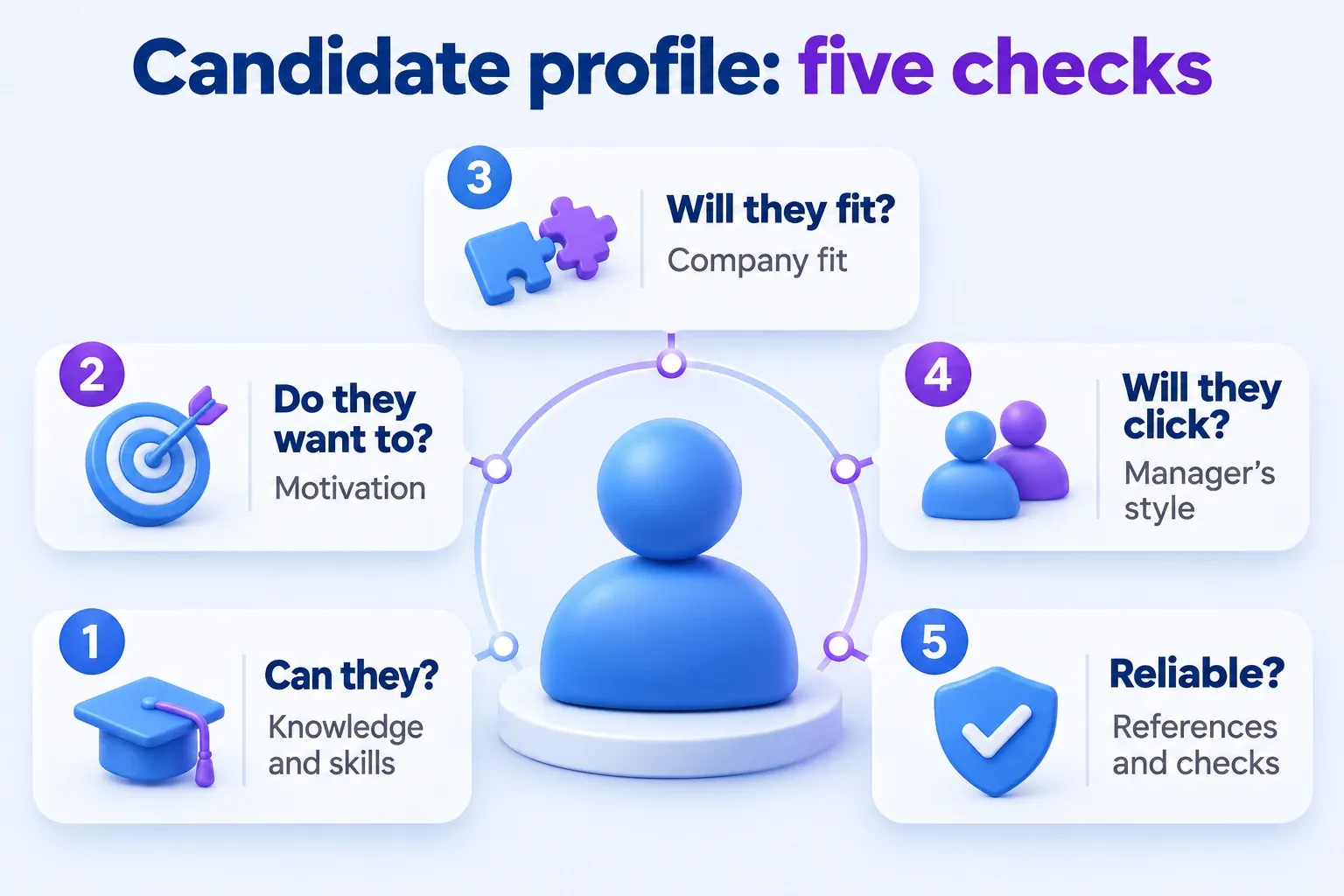
A candidate profile isn’t a wish list; it is a set of requirements you can verify. It helps to ask five questions about the person:
- Can they do the job? Knowledge, skills and experience they can’t start without. The hiring manager usually checks this in depth, but the recruiter should make sure the candidate has at least worked on such tasks.
- Do they want this? Motivation. Compare the candidate’s expectations with the actual conditions and discuss any differences before making an offer.
- Does the team’s way of working suit them? Discuss observable requirements such as shared decisions, written communication or independent work. Personal similarity to the interviewer is not a job requirement.
- Will they work well with this manager? Whether the management style suits them and whether they can report to that specific person without creating tension in the team.
- Are they reliable? Background checks, references, the overall picture from the interview. Define the purpose and limits of such checks before the search starts.
Separately, distinguish the ideal profile from the must-have criteria. You have to search the market you have, so you need a compromise between what you want and what exists.
One trap is “I want someone just like Vasyl.” The profile is copied from a former or current employee who was a one-of-a-kind specialist. People like that may simply not exist on the market, and the search drags on for months. The same goes for a marketer who is supposed to run ads, write the strategy, create content and also do the design.
For a role with established occupational requirements, a relevant professional standard can provide an additional reference. Compare it with the actual work and separate essential qualifications from skills that can be learned after joining.
3. What does the candidate get?
The employer value proposition answers a simple question: why should a good specialist leave their current job and join you? If this part is empty, everything else — the job post, the ads, the search — is wasted: the candidate can’t tell you apart from a hundred other vacancies.
A few rules:
- Every role needs its own offer. An accounting vacancy might explain the workload during reporting periods; a sales vacancy might explain how bonuses are calculated. Ask candidates about their priorities rather than inferring them from a job title. That isn’t a contradiction: both can coexist in one company.
- Explain what the candidate gets. Replace a list of demands with concrete responsibilities, conditions and opportunities. Explain how each requirement connects to the work.
- Explain your requirements. Not “fluent English,” but “you need English because you’ll talk to international clients every day.” That way the person sees why the requirement exists and can assess themselves.
- Avoid templates. A post generated only from the job title may omit what the work actually involves. Add real tasks, conditions and success criteria so candidates can assess the offer before an interview.
Generic phrases about a “friendly team” and “growth opportunities” don’t replace specifics: what the person will own, who they will work with, how their results will be measured.
If you don’t know what matters to your candidates, ask. Go to people who already work for you in similar positions and show them a draft of the post. If you have none, find a few specialists on the market. A few conversations can reveal unclear wording. Treat them as qualitative feedback rather than a representative view of the market.
4. Where should you look for candidates?
Match the channel to the role and to how your target candidates behave. For cashiers, start by testing local channels and job sites rather than reusing an executive-search approach without evidence. Brand managers, on the other hand, are often hired by recruiting agencies without publishing the vacancy at all: through their own database, industry contacts and direct messages to specialists at the right companies.
Also consider who competes for the candidate’s attention. Niche specialists, such as bakery technologists, will most likely compare you to other producers. For a cashier, the competitors are every employer nearby: shops, cafés, service companies with a similar schedule and pay.
Judge a channel not by the number of applications, but by how many people from it meet the requirements, reach the interview, accept the offer and pass probation.
5. How should the candidate journey work?
The candidate journey starts not with the interview but with the first contact with the vacancy. Everything matters: how many steps it takes to apply, how fast you respond, how many stages and test tasks there are, how decisions are made and whether the person gets feedback.
The simplest check is to go through this journey yourself. Open your vacancy, apply, count the steps and the days of waiting. Even better, ask an outsider to go through it as a candidate. And ask real candidates who turned you down why that happened and what stopped them.
What else affects the result
A vacancy doesn’t exist apart from the management style, team culture and market situation. Two companies can look for a person with similar experience but explain the role, communicate with candidates and make decisions differently — and get completely different results.
How to check a vacancy before publishing
Before opening a vacancy, the hiring team — the recruiter and the hiring manager — goes through the five questions in a short meeting and records the answers in the role description. For a vacancy that has been open too long, start with the first question, not with an advertising budget.
The check doesn’t guarantee that every role will close quickly. But it gives the team a shared language and helps you understand what exactly to change: the content of the role, the profile, the offer, the channels or the process.
Related practical guides
You can map the agreed selection steps in the Recuite hiring pipeline.